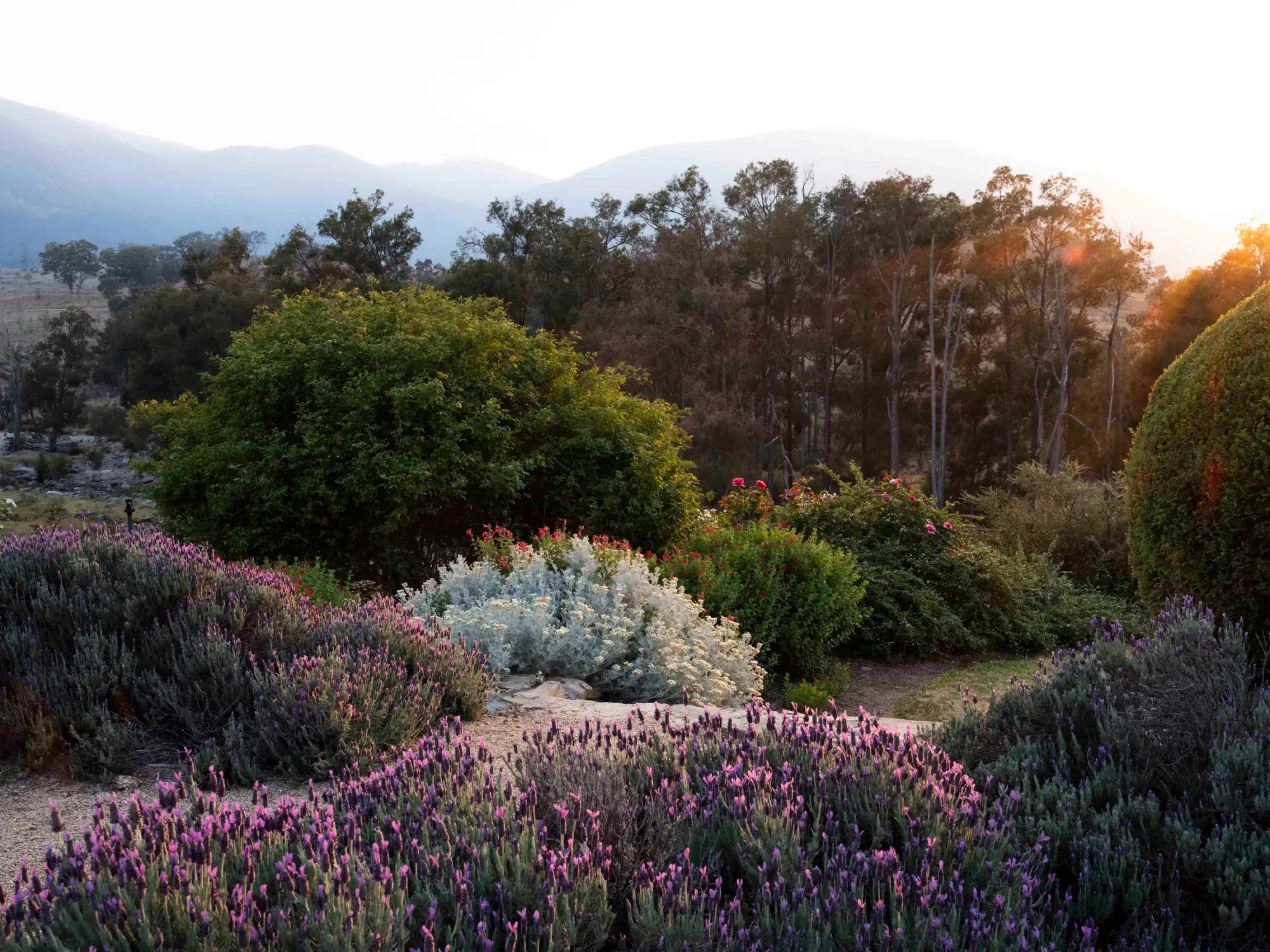
Tenterfield gardener Carolyn Robinson shares her planting wisdom.
A note to the reader: Carolyn Robinson put together this guide to help customers navigate a special plant sale in conjunction with the her Eagles Bluff open garden weekend. Galah has published the guide here because, given it is full of valuable tips and plant combinations, it may be of service to readers after the plant sale has finished.
All plants will be happier and easier to maintain if planted into a prepared garden bed where the soil has been dug over or cultivated and then mulched, rather than planted into lawn. Every plant on this list – with the exception of the grevilleas – will also be grateful if manure or compost can be incorporated. Surface mulching is imperative.
Back row: Eucalyptus sideroxylon (Mugga ironbark), planted 8m apart, to break high winds.
Front row: Melaleuca linariifolia (snow-in-summer) planted 4m apart, or Melaleuca decussata (totem pole honey myrtle) planted 3m apart.
Acacia pendula (myall)
Useful as an informal hedge, or balled to mark a focal point in a border.
Eucalyptus sideroxylon as the main feature.
Behind the tree, Eremophila Fairy Floss and Atriplex Silver Holly. Around the front of the tree, Helichrysum petiolare (licorice plant).
Surrounding groupings can include clipped Ulmus Seiju, Philotheca myoporoides subsp. acuta, Salvia leucantha Red Harry, Leptospermum Cardwell, Callistemon pityoides pink (alpine bottlebrush), Eremophila Magic Blush and Casuarina Cousin It.
A note: it is important that all these plants go in together while the tree is young, so the surrounding plants can establish before the tree grows too large. They are happy with some shade and tree-root competition, although in dry times some irrigation will be necessary.
Buddleja crispa (Himalayan butterfly bush) as the central feature, surrounded by groupings of Baeckea virgata La Petite, Callistemon pityoides pink, Correa Cardinal Bells, Salvia leucantha Red Harry, Spiraea japonica Anthony Waterer and Brachyscome Mauve Delight.
Ceanothus Marie Simon as the main feature, either as a row or a small group, associating with groupings of Lavandula x heterophylla (sweet lavender), Agastache Sweet Lili, Eremophila maculata cerise, Westringia Smokey, Deutzia gracilis Nikko and Myoporum parvifolium purpurea.
A note: Ceanothus Marie Simon is happiest in full sun, without the close competition of trees.
Ceanothus Gloire de Versailles behind Spiraea japonica Anthony Waterer, with a front border of Salvia Berggarten.
Callistemon Purple Splendour behind Baeckea virgata La Petite, with Grevillea lavandulacea Black Range and Rosmarinus Majorca Pink (clipped into balls) interspersed in the foreground.
A copse of Ulmus Seiju, left unclipped, underplanted with mounds of Helichrysum petiolare.
Eremophila Fairy Floss grouped with Lavandula x heterophylla and Berberis Silver Beauty, bordered by Westringia Smokey and/or Stenanthemum scortechinii.
A clipped row of Rosmarinus creticus with Leptospermum Cardwell, Correa Cardinal Bells and Grevillea lanigera Mt Tamboritha in the foreground.
Melaleuca decussata as a background planting.
Mixed middle-storey combinations of Grevillea Winpara Gold, Grevillea Iced VoVo, Melaleuca Warialda, Grevillea Carol Ann and Grevillea Apricot Charm.
At the front of the border, groupings of Grevillea lanigera Mt Tamboritha, Philotheca myoporoides subsp. acuta, Stenanthemum scortechinii and Callistemon White Anzac.

$8.50 a tube. Order online by 20 September 2026 and collect from the garden on the open garden weekend, Saturday 17 and Sunday 18 October, 9.30 am to 4 pm. No postage, and no sales at the gate. Garden entry ($20 a head) is separate.
Carolyn’s first book, A Garden Is Not a Painting, comes out in March 2027 – a beautifully made hardcover, with photography throughout by Brigid Arnott. Pre-order – $70, or take it with garden entry as the Garden Entry + Book Pre-order for $90 with postage included.
